
The best Data Scientists are NOT just using AI
They are orchestrators & builders of AI too.

I’m going to say something a little controversial.
If you want to thrive in a Data Science career, knowing how to use AI is not enough. Using Claude Code, Cursor, Codex etc to write code faster is the baseline expectation now. That’s the most basic skill you are expected to have.
If you really want to succeed in the AI era as a Data Scientist, you need to do work that increases AI’s leverage at your company.
You can’t just be a user of AI. You need to be a builder and orchestrator of AI.
I’ve spoken to 10+ senior leaders of Data teams from Google, Intuit, eBay, Meta and more, and this shift is clear.
The most exciting part is that Data professionals and Data teams are moving into roles where they lead AI strategy and implementation. And they are THRIVING. They have increased their influence, and they have increased their impact.
So how do you start to drive AI strategy and implementation at your company? Here are the steps, and I’ll walk through each one in more detail below.
Understand the pillars of AI strategy
Rate your org’s proficiency in each pillar, then rate your own influence
Plot each pillar on the Leverage Axis
Prioritize projects in Your Edge (high impact, high influence)
Step 1: Understand the pillars of AI strategy
I like to break this down into 4 pillars:
Implementation: this is the actual work of putting AI solutions into production and monitoring them.
Data foundation: this is anything around the data infrastructure and the semantic layer that allows AI to do its work well.
Governance: everything around security, risk and building a scalable, strategic AI program.
Measurement: this is about tying your AI initiatives back to business value, and using that measurement to prioritize and drive future initiatives.
Step 2: Rate your org’s proficiency in each pillar, then your influence
Now that you understand the four pillars, rate how good your org is in each one. Then look internally and ask yourself: how good am I at driving change in this area?
Be honest here. Inflated ratings will lead you to prioritize the wrong projects later.
Step 3: Plot each pillar on the Leverage Axis
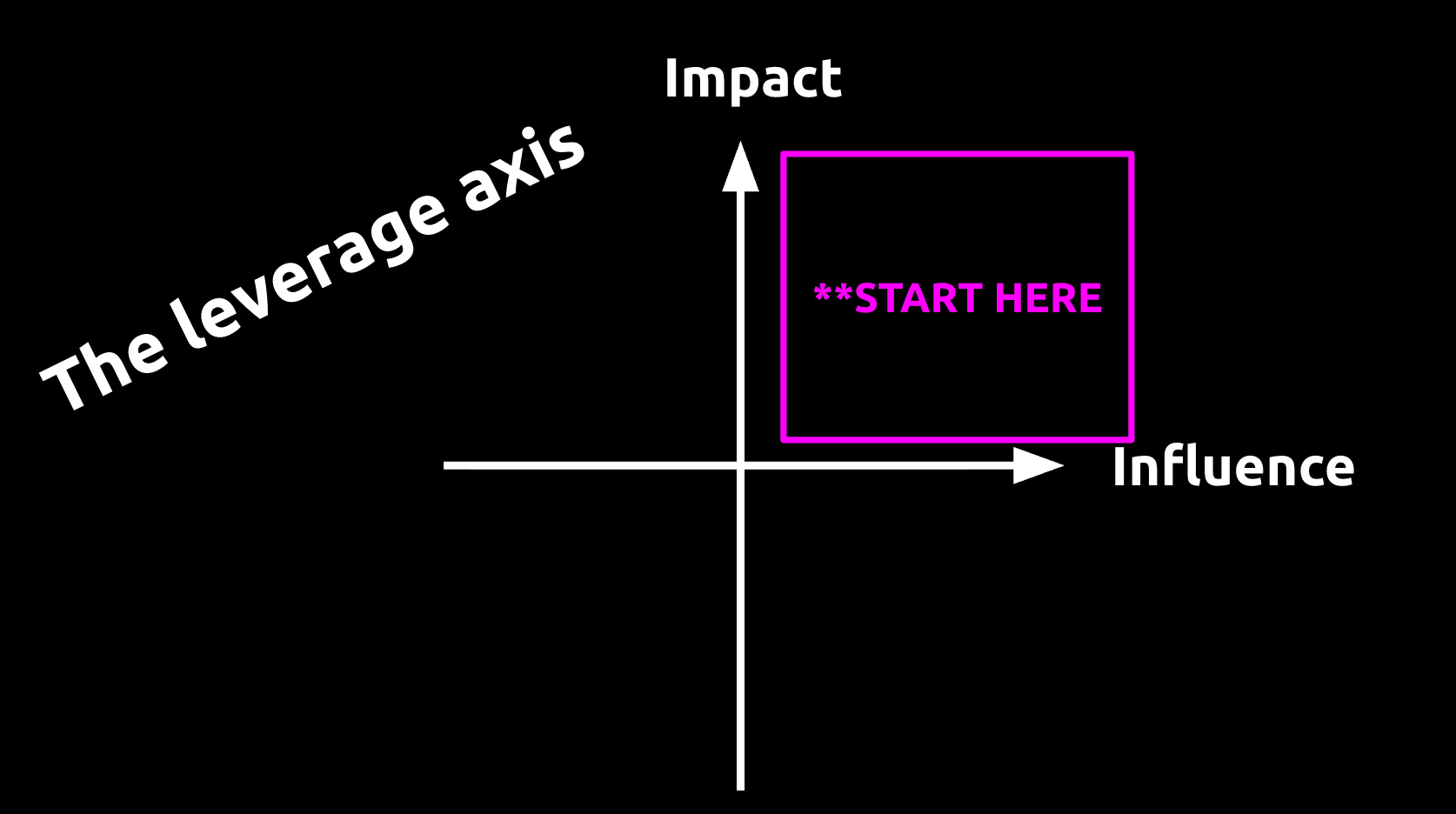
There are two pieces to this, Impact and Influence. I call this the Leverage Axis (see image below).
On the y-axis, we have Impact. This is how much opportunity there is to improve in each pillar. Typically, the less sophisticated your company is in a given area, the more likely you can land impact there. If a pillar is already “good,” there’s less room to move the needle. If it’s “bad,” the upside is huge.
On the x-axis, we have Influence. This is how much control YOU currently have in each pillar, given your role, your team’s scope, and the stakeholders you already have relationships with.
Plot each of the four pillars onto this axis.
Step 4: Prioritize projects in Your Edge (high impact, high influence)
Once everything is plotted, prioritization becomes really, really simple. The top-right quadrant is what I call Your Edge: high impact AND high influence. These are the projects where you can move the needle quickly, because you have the control to actually drive change.
To make this concrete, here are 4 real case studies of how Data teams are already driving AI strategy across each of the pillars. These all come from my conversations with Data leaders from companies like Google, Intuit, eBay, Meta and more.
These are NOT the only ways to drive impact in each of these pillars, but I hope it gives you some inspiration!
Case studies
Case study #1 (Implementation): AI agents for 100% sales coverage
A Data Science team at a big tech company helped their Sales partners increase account coverage with AI agents.
Old: Rank all accounts with a model, only support the top accounts.
New: Assign every account to an AI agent by default, then route the accounts that need human help to the sales team.
Impact: Close to 100% coverage on sales accounts.
Case study #2 (Data foundation): Fixing the semantic layer for consistent AI responses
A team at a big tech company fixed inconsistent AI agent outputs by upgrading the data layer underneath, not the model on top.
Old: Point an AI agent at fragmented data sources.
New: Give the agent semantic context, so it pulls from the same place the same way every time.
Impact: Big reduction in the variability between AI responses.
Case study #3 (Governance): Process change in governance maturity assessment
Not all impact has to be “technical” in nature. I really appreciated this example from an airline company, on how they influenced behavior changes by building trust.
Old: Send a pre-survey asking stakeholders to self-report their governance maturity.
New: Sit on the call with stakeholders and walk through the maturity assessment live, so they see their own gaps in real time.
Impact: Increased trust in AI tools, and adoption of Microsoft Copilot jumped to 70%.
Case study #4 (Measurement): Metric framework for AI initiatives
I love this one. An innovation team (responsible for AI initiatives across the org) deepened their measurement and understand of AI’s impact.
Old: Track logins and token usage as the signal of AI adoption.
New: Track 4 layers of the funnel, getting closer to real value at each layer:
Adoption & Usage: Logins and token usage (curiosity signal)
Workflow Retention: AI used on real work tasks, not just sandbox experiments
Internal Advocacy: Same prompt or agent picked up by another person or another project
Business Impact: Higher coverage, higher quality, reduced cycle time
Impact: The team could look at AI initiatives across the company and intelligently decide where to invest.
These are not the only ways to have impact in each pillar. They’re just the case studies I found most interesting, and I hope they give you some inspiration for what’s possible in Your Edge.
I’d recommend picking 1-2 projects from your High Leverage quadrant to start. Don’t try to boil the ocean. Pick the project where you can show a clear win in the next 1-2 quarters, and use that momentum to expand into the other quadrants over time.
Want a more concrete, personalized plan?
The framework above gives you the shape of where to focus. But the real magic is when you go a layer deeper and figure out exactly which projects to prioritize for YOUR role, YOUR org and YOUR level of influence.
I built a tool that asks you specific questions about your org’s current sophistication levels and your level of influence in each pillar. It then generates a personalized action plan with concrete project ideas tailored to your situation, not generic advice.
If that sounds useful, you can check it out here: https://form.typeform.com/to/dkgmG64W
The questionnaire takes around 7 minutes, and you’ll get your personalized action plan in your email just a few minutes after!