

If you are a data professional in your organization and think being able to prompt makes you AI savvy, think twice..
Companies today are still early in their AI maturity meaning they mostly use chat-based tools like ChatGPT and Claude, or coding assistants like Claude Code. That makes them AI-enabled, but not AI-native.
And the same distinction applies just as much to individuals as it does to organizations.
We conducted a survey of 100+ companies alongside qualitative interviews with 10 senior leaders and executives of Data teams. The report covers how data professionals are experiencing the shift, where organizations are successfully making progress, and where the gap remains in a fast-moving AI space.
Most people are stuck at the entry-level for AI tools
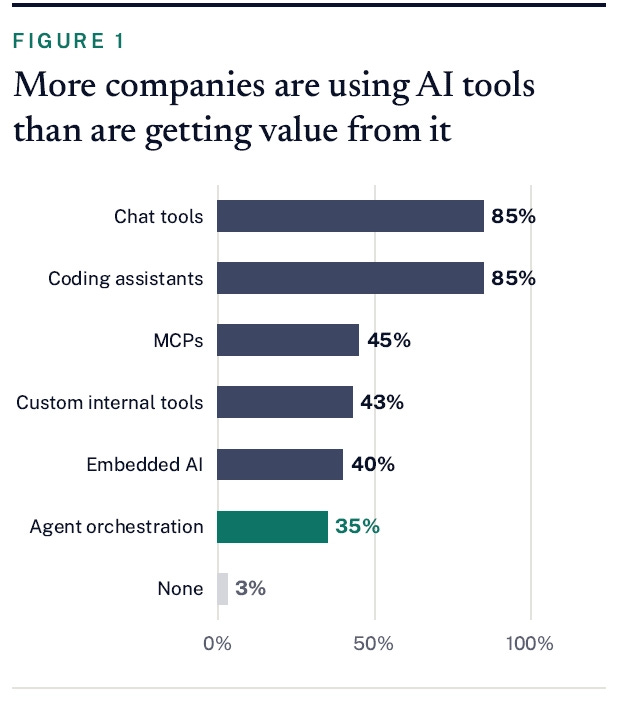
Almost everyone (85%) has adopted entry-level AI tools chat assistants and coding assistants. But usage falls by roughly half once you get to more advanced capabilities like MCPs, custom internal tools, agent orchestration.
This shortfall in usage numbers is exactly where there is an opportunity to be AI native meaning while its easier to use chat tools, far fewer people know how to build with MCPs or orchestrate agents.
Basic usage isn’t translating into the kind of maturity that is required from companies
Despite near-universal adoption of chat tools and coding assistants, only 28% of companies report real efficiency gains, and only 24% are even measuring impact. Basic adoption alone isn’t creating value companies can see or measure, and that gap is telling: it’s the deeper, harder-to-adopt capabilities that seem to be where the real payoff sits, not the tools everyone already has.
For individuals the implication is that being “AI-enabled” or able to use a chatbot is now table stakes. It won’t set you apart, and it won’t drive real business impact on its own.
But if you invest in becoming AI-native and be comfortable with MCPs, building internal tools, orchestrating agents then you are the one positioned to actually move the needle, influence decisions that build impact which companies can see and measure.
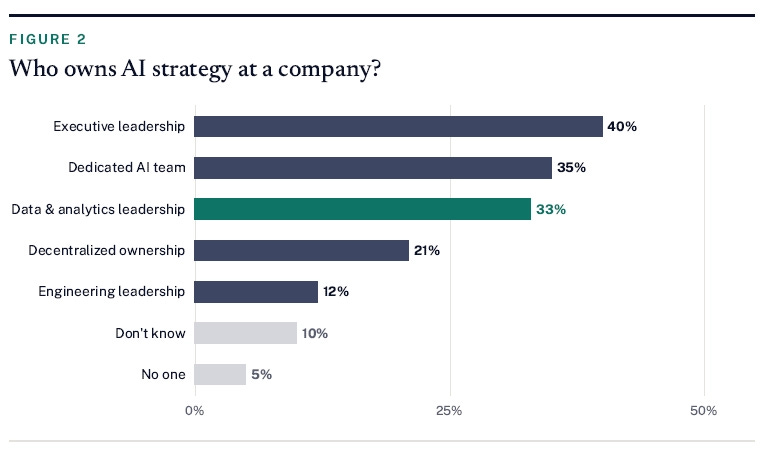
Our survey results showed that data leaders who’ve evolved into building and implementing AI strategy are already seeing the payoff: they were identified as a usual driver of AI adoption by 33% of respondents, placing them third only behind executive leadership and dedicated AI teams. That’s not proof that building AI strategy is what handed them influence rather than seniority they already had, but it’s a strong signal worth taking seriously.
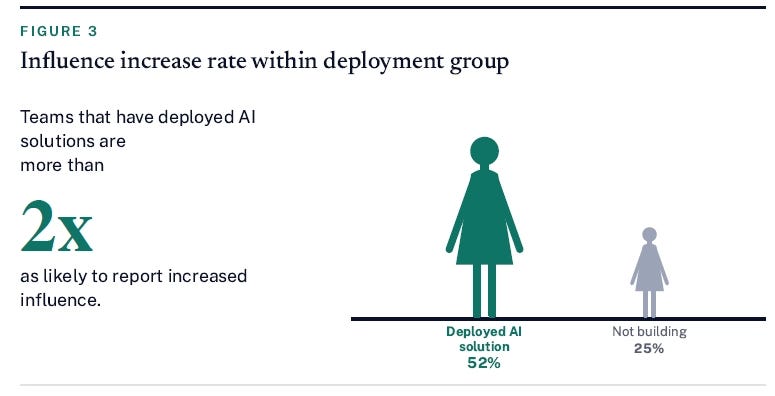
Teams that have deployed AI solutions are more than 2x as likely to report increased organizational influence. If that pattern holds at the team level, it’s reasonable to expect it plays out for individual contributors too: those who build with AI, not just chat with it, are the ones positioned to increase their influence and expand their scope, regardless of title. They are the ones best placed to lead AI strategy forward.
While becoming an AI native is where the opportunity lies ahead, technical skills alone won’t save you
To be clear, the technical skills that are losing their edge and the ones I’m describing above aren’t the same thing. The traditional path that required you to master statistics, learn Python or SQL, build models or databases — is no longer the clear competitive edge it once was. As AI increasingly handles routine coding and orchestration work, skills that took years to build are becoming accessible to anyone with the right tools. As one leader we surveyed put it: “the moat is gone.” But being AI-native, comfortable with MCPs, agent orchestration, building internal tools, isn’t that same old moat; it’s the new baseline technical fluency, and on its own it’s still not enough.
That doesn’t mean data professionals are being replaced in large numbers, our survey results don’t support that. What’s actually happening is a shift in roles and responsibilities: 52% of respondents reported role boundaries blurring, with overlapping responsibilities across disciplines like data engineering. 43% say data roles now require soft skills like communication, storytelling, and stakeholder management, and 42% report needing more cross-functional collaboration.
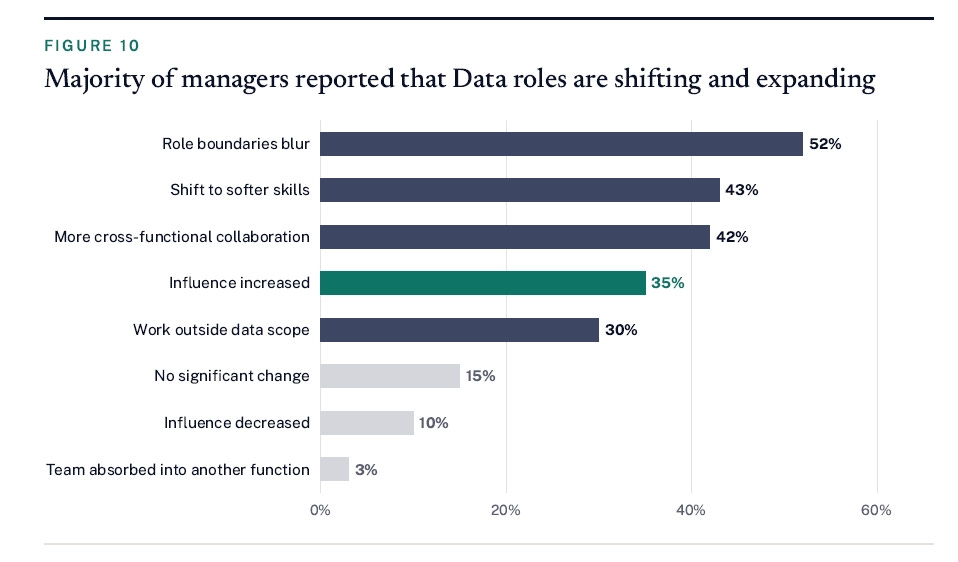
The people seeing their value grow aren’t the ones with the deepest technical skills, they’re the ones combining AI-native technical fluency with soft skills like communication, storytelling, and stakeholder management, and cross-functional collaboration. Technical fluency gets you in the room; soft skills are what let you turn that into influence.
Which is why you should know AI to build influence in your organization and also learn to combine technical skills with the right kind of soft skills to build influence in your organization through AI solutions deployment.
The different stages of AI maturity
You must be wondering where that leaves you and your organization in AI maturity.
Our survey grouped organizations into four AI-maturity stages. Most data teams are still stuck in the ‘messy middle’: 43% are ‘Momentum Builders actively experimenting with AI but lacking the foundations to scale it and 30% are “AI Operators,” building or deploying more seriously but with uneven results. Only 8% qualify as true “AI-Ready Leaders,” and 18% are “Foundation Builders” with stable data operations but no real AI layer yet.
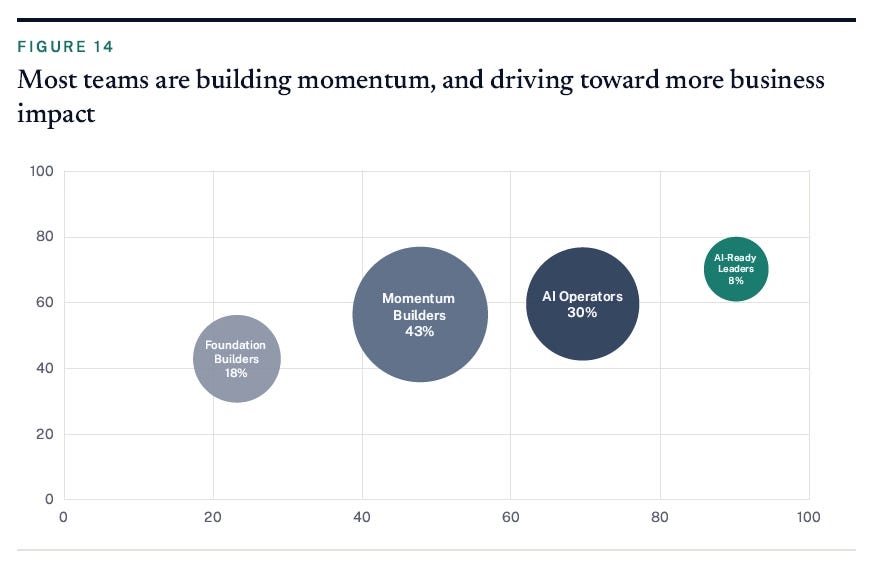
While we’ve already established that being AI-native and by extension, becoming an AI-Ready Leader is where the opportunity lies, it’s also true that most professionals, and most teams, are working inside organizations still figuring this out.
And that same dynamic plays out at the individual level: which means there’s still time to be the person who pushes your skills, and your team, toward that top 8% or instead of limiting yourself to prompting and chatting with AI tools. The bar for “using AI” has already been cleared by almost everyone.
If you want to read the full 40+ page report including all the interviews with data leaders and the additional survey charts you can get it here: sowhatdata.io/industry-report